

Why Switching Luxury Real Estate Brands Without Strategic Marketing Is a $10 Million Mistake
Your team just closed $150 million in sales. You are the recognized expert in your market. Your clients trust your name above all else.
Then you switch from Sotheby's International Realty or another brokerage to Compass. Or from Compass to another brokerage.
Overnight, everything changes. Your logo. Your brand colors. Your yard signs. Your email signature. The very visual identity your clients have associated with excellence for years suddenly looks completely different.
And here is what most teams discover too late: without experienced marketing leadership during this transition, you risk losing the one thing that drove your success in the first place. Client trust.
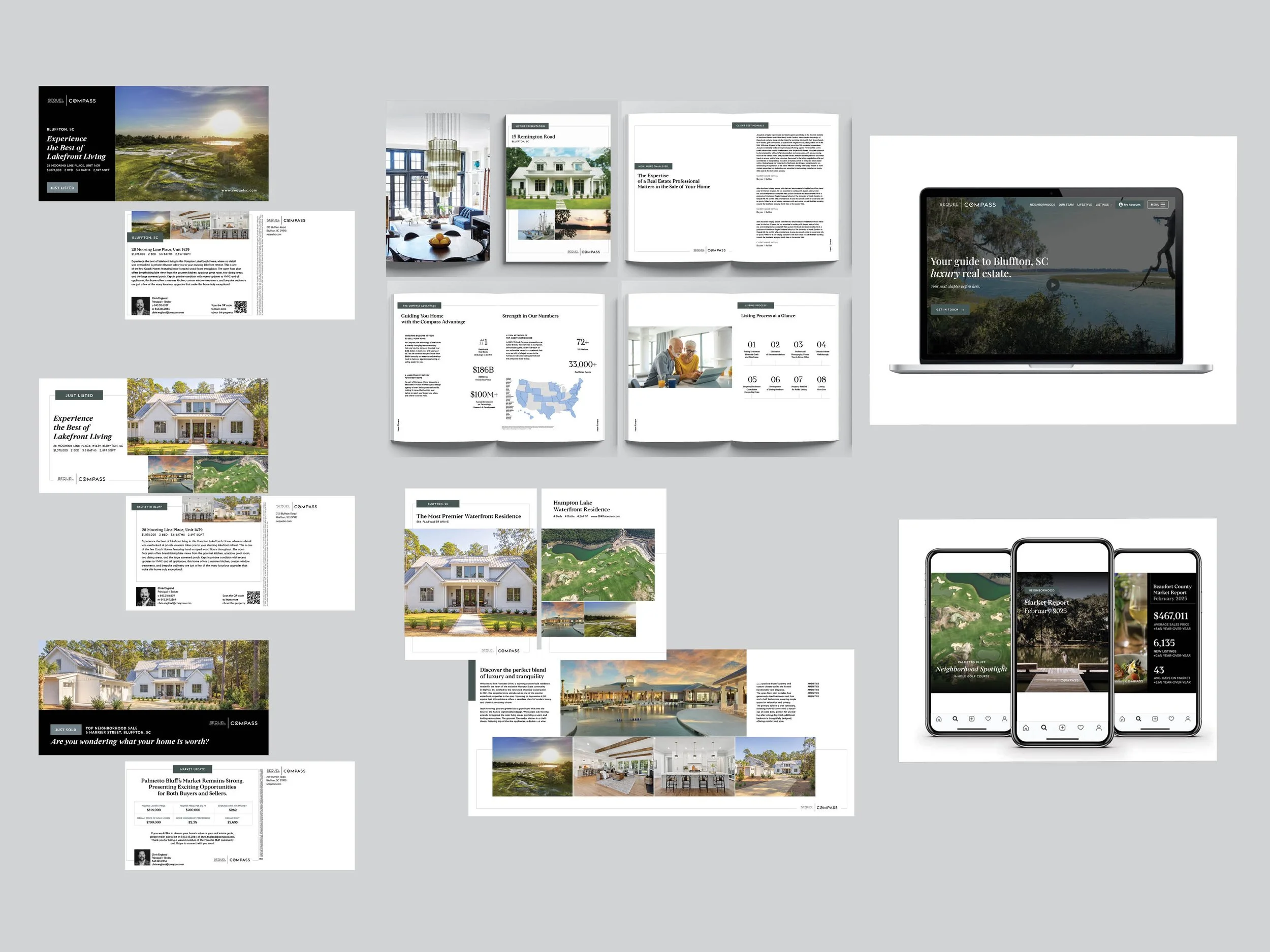
Sequel Real Estate, Bluffton, SC Collateral for their transition to Compass
The Hidden Cost of Brand Transitions in Luxury Real Estate
When a top-producing team changes brokerages, the immediate focus goes to contracts, commissions, and logistics. But there is a deeper challenge that often gets overlooked until it is too late.
Your personal brand and your brokerage brand are intertwined in your clients' minds. Successful brands own a specific position in the consumer's mind. When you change brokerages, you are asking your clients to rewire years of mental associations.
That Sotheby's International Realty sign in their front yard was not just a marker. It was a symbol of prestige, trust, and proven results. When it becomes a Compass sign, your clients need reassurance that the expertise they valued has not changed, only the uniform. You did not make this decision lightly and you did it on behalf of your customers. You need an experienced marketer to help you deliver the additional value you can provide to your clients. You need assistance communicating the reason you decided to change and elevate your team to a new brand and brokerage.
This is where consistency becomes critical. Marketing success depends on showing up consistently with the same message, the same quality, and the same professionalism. A brand transition tests this consistency in ways that can either strengthen client relationships or quietly erode them.
The challenge is this: you need to communicate continuity while embracing change. You need to honor the brand standards of your new brokerage while maintaining the personal brand that made you a market leader. You need to reassure existing clients while attracting new ones under a different banner.
Most teams try to handle this themselves. Leaning into the new brokerage for their regional marketing employees. But what exactly is their experience in developing and nurturing a new brand? How long does this on-ramp last to carry you through your new transition?
They update their website, order new business cards, and hope everything falls into place. But strategic brand transitions require more than updated initial collateral. They require a comprehensive marketing strategy that addresses every client touchpoint, from social media to email campaigns to property marketing materials and more.

Brand Transitions Are Happening Now More Than Ever
The real estate industry continues to see significant movement. In 2025 alone, at least seven high-producing luxury teams made the move to Compass Real Estate, with combined sales records totaling billions of dollars. These teams came from established brands like Douglas Elliman, Coldwell Banker, and Brown Harris Stevens. With Anywhere on the verge of a merger with Compass, how many teams are jumping into the new space all at once?
Each of these transitions represents the same challenge: maintaining client trust and market position while adapting to new brand standards and systems.
Compass is a great real estate brokerage with extensive technology offerings. Their platform includes AI-driven pricing tools, marketing automation, seamless transaction management, private exclusives, and sophisticated CRM systems. The challenge many teams discover is that with so many technology options available, it can become overwhelming to jump-start your brokerage into a new brand effectively.
That is precisely where experienced marketing leadership becomes invaluable. Having someone who understands both the technology capabilities and the strategic implementation needed to maintain your market position during the transition makes the difference between a smooth evolution and a disruptive upheaval.
Why Brand Transition Experience Is Nearly Impossible to Find
Here is the reality: very few marketing professionals have navigated luxury real estate brand transitions at the highest level. Most marketers work within a single brokerage living in their own silo. They understand one brand's standards, one set of guidelines, one approach to positioning.
Having served as Marketing Director for top teams at both Sotheby's International Realty and Compass Real Estate gives me a perspective that is almost nonexistent in the industry. I have lived through the nuances of conforming to different brand standards while maintaining team identity. I have managed the process of changing every visual element while preserving the trust that clients place in consistent, expert service.
This is not theoretical knowledge. I was the Marketing Director for the number one ranked Vail Valley real estate team, helping drive annual sales from $100 million to over $200 million. I have worked with founding agents at Compass, growing their business volume from $10 million to over $60 million through targeted luxury marketing strategies.
These results came from understanding that in luxury real estate, your clients are the heroes of the story. Your role is to be the trusted guide who helps them achieve their goals. When you change brands, you must reinforce that you are still the same guide, just with different tools and resources to serve them even better.
I have managed the full spectrum of brand transition challenges:
Developing messaging that honors both your personal brand and your new brokerage's positioning
Creating marketing materials that meet strict brand standards while highlighting your unique value
Coordinating the rollout of new visual identity across all marketing medium
Maintaining social media presence and engagement throughout the transition
Ensuring every client communication reinforces continuity and expertise
Repositioning your team's market presence without losing the position you have earned in clients' minds
The Strategic Value of Fractional Marketing Leadership
Small to mid-sized real estate teams face a difficult choice. They recognize the need for senior-level marketing expertise, especially during critical periods like brand transitions. But hiring a full-time Marketing Director often means a $250,000+ annual investment in salary, benefits, and overhead.
This is where fractional marketing leadership becomes invaluable.
As a Fractional Marketing Director, I provide the same strategic thinking, creative execution, and industry knowledge that comes from 30 years of proven results in luxury real estate marketing and many other industries. You get senior-level expertise scaled to your specific needs and budget.
For teams navigating a brand transition, this means having an experienced professional who has successfully managed this exact challenge multiple times. Someone who knows how to maintain brand consistency while adapting to new standards. Someone who understands the psychology of luxury buyers and how to position your services effectively in a competitive market.
For established teams looking to scale, it means having strategic marketing leadership without the overhead of a full-time executive position. You get the expertise to develop comprehensive marketing strategies, create high-quality content, and execute campaigns that drive real business results.
The difference between working with a generalist marketer and someone with specific luxury real estate brand experience is measurable. It shows up in client retention during transitions. It appears in how quickly your new brand presence gains market traction. It is reflected in your ability to command premium pricing and maintain your position as the recognized expert in your market.
Your Next Step
If you are considering a brand transition, planning to scale your team's marketing efforts, or looking to elevate your market position, strategic marketing leadership is not optional. It is the difference between maintaining momentum and watching your market share slowly erode. If you have succeeded in the past 10 years or more, you know that even in a downturn of the market, it is the ones that invest in marketing that win. It is never a time to retreat. Become a marketing company that happens to sell the local lifestyle and real estate and you will position yourself ahead of the competition.
The question is not whether you need experienced marketing expertise. The question is whether you can afford to navigate critical business decisions without it.
Let's discuss how fractional marketing leadership can help you maintain brand consistency, strengthen client relationships, and position your team for continued growth, whether you are staying with your current brokerage or making a strategic move.
Visit BariWiensMarketing.com to learn more about working together, or reach out directly to schedule a consultation. I stay on top of AI trends in the creative strategy space which allows me to create double the amount of output in half of the time as a traditional marketer and designer.
Your expertise built your reputation. Strategic marketing ensures it continues to grow.
-
A fractional marketing director is a senior-level marketing professional who provides strategic marketing leadership to real estate teams, brokers, and brokerages on a part-time or project basis. Instead of hiring a full-time Marketing Director with a salary of $250,000 or more annually, you get the same expertise, strategic thinking, and execution capabilities scaled to your specific needs and budget. For luxury real estate teams, this means access to someone who understands high-end property marketing, brand positioning, and client psychology without the overhead of a full-time executive position.
-
A strategic real estate brand transition typically requires 3 to 6 months for full implementation. This includes updating all marketing materials, coordinating the rollout across active listings, repositioning your online presence, maintaining client communication throughout the change, and ensuring every touchpoint reflects your new brand identity while preserving your personal brand equity. Teams that attempt to rush this process or handle it without marketing expertise often experience gaps in consistency that can erode client trust and market position.
Those looking for measurable results should expect at least a 7-12 month implementation. -
Luxury real estate teams need comprehensive marketing services that go beyond basic property promotion. This includes strategic brand positioning, high-quality content creation for listings, social media management, email marketing campaigns, website development and maintenance, professional photography and videography coordination, client communication strategies, and market positioning analysis. For teams working with properties above $5 million, marketing must emphasize lifestyle, exclusivity, and the emotional connection buyers have with luxury real estate rather than simply listing features and square footage.
-
Compass Real Estate offers extensive technology platforms including AI-driven pricing tools, marketing automation, private exclusives, CRM systems, and transaction management tools. While these resources are powerful, the sheer number of options can be overwhelming for teams transitioning to the platform. Marketing expertise helps you strategically select and implement the right tools for your market, maintain brand consistency during the transition, leverage Compass technology effectively, and integrate new systems without disrupting client relationships or losing momentum in your business.
-
Marketing luxury homes requires a fundamentally different approach than general real estate marketing. Luxury buyers are motivated by lifestyle, legacy, and emotional fulfillment rather than practical considerations alone. Marketing must showcase unique architectural details and artisan craftsmanship, emphasize privacy and exclusivity, highlight sustainability and wellness features, create experiential content that tells a story, and position properties as long-term legacy assets. Generic real estate marketing tactics that work for homes under $1 million typically fail in the luxury market where buyers expect museum-quality presentation and sophisticated positioning that reflects the caliber of the property itself.